Product discovery in furniture ecommerce: A Shopify guide

Nearly 70% of furniture shoppers abandon their carts before buying, and the culprit is rarely price. It's discovery friction. Understanding what is product discovery in furniture ecommerce is the first step to fixing a problem that costs Shopify retailers real revenue every single day. When customers can't find what they're looking for quickly, or can't visualize whether a sofa will actually work in their living room, they leave. This guide breaks down exactly how modern AI-powered discovery works, why furniture has unique challenges, and what you can do right now to close the gap.
Table of Contents
- What product discovery means in furniture ecommerce today
- Challenges unique to furniture product discovery and how AI helps overcome them
- Comparing traditional furniture search with AI-powered product discovery
- Strategic steps for furniture retailers to implement AI-powered discovery effectively
- Maximizing customer engagement with AI furniture visualization
- Why product discovery is a data problem, not just a UX problem
- Explore AI furniture visualization tools to transform your Shopify store
- Frequently asked questions
Key Takeaways
| Point | Details |
|---|---|
| Product discovery defined | Modern furniture product discovery uses AI to help customers find and choose products naturally and quickly. |
| Data infrastructure matters | Clean, structured product data is critical for AI tools to work and improve discovery effectively. |
| AI visualization boosts sales | Showing furniture in customers' real rooms using AI increases confidence and conversion rates. |
| AI exceeds traditional search | AI understands shopper intent and adapts results dynamically, unlike static keyword search. |
| Omnichannel strategy | Combine AI online tools with in-store experiences to guide customers through the full purchase journey. |
What product discovery means in furniture ecommerce today
Product discovery is not just search. That distinction matters enormously in furniture retail, where a shopper might type "cozy reading chair for small apartment" and your catalog returns zero results because your product is tagged "accent chair, compact." Traditional keyword search is a rigid system built around exact matches. It doesn't interpret what a shopper actually wants.
Modern product discovery is the end-to-end process of helping shoppers find, evaluate, and choose products through AI-driven search, personalized recommendations, and interactive visualization. It uses machine learning and natural language processing to understand intent, not just words. That's a fundamental shift from reactive search to proactive surfacing.
For furniture ecommerce in 2026, discovery now includes:
- Semantic search: Understanding "warm-toned sectional for open-plan living" without needing an exact tag match
- Behavioral personalization: Showing products based on what a shopper has browsed, saved, or lingered on
- Visual search: Letting customers upload a photo of a room or a piece they love and finding similar products
- Conversational queries: Responding to natural language like "something that goes with my mid-century dining table"
- Proactive recommendations: Surfacing complementary items before the shopper thinks to ask
The AI-driven shift in furniture placement is already changing how customers interact with product pages. Discovery is no longer a search bar at the top of your site. It's every touchpoint where a shopper decides whether to keep looking or walk away.
Challenges unique to furniture product discovery and how AI helps overcome them
Understanding the concept of AI-driven discovery, let's explore the key challenges furniture retailers face and how AI tools specifically address them.
Furniture has a language problem. Shoppers describe products the way they feel, not the way they're cataloged. A customer searching for "something that doesn't make my room feel cramped" is expressing a need that no keyword filter can satisfy. 41% of furniture shoppers frequently rephrase their searches because the results don't match their intent, and that friction drives cart abandonment directly.
Here's what makes furniture discovery uniquely hard compared to other ecommerce categories:
- Scale and variation: A single sofa model might come in 30 fabric options, 4 leg finishes, and 3 configurations. Without structured data, AI can't surface the right variant.
- Emotional decision-making: Furniture purchases are high-stakes. Shoppers need to feel confident, not just informed. That requires more than a product photo on a white background.
- Spatial uncertainty: No other product category asks the buyer to mentally calculate whether something will physically fit and look right in a specific room.
- Long consideration cycles: Furniture shoppers often browse for weeks. Discovery tools need to re-engage them across sessions, not just serve them once.
AI visualization tools solve the spatial uncertainty problem directly. When a customer can upload a photo of their actual living room and see your sofa placed inside it, hesitation drops. AI-powered visualization tools lift conversions by 22% by giving shoppers the confidence that comes from seeing a product in their own space.
The psychology behind furniture visualization is worth understanding. Shoppers don't just want to see a product. They want to see themselves owning it. That emotional connection is what AI visualization creates, and it's what static product photography can't replicate.

Pro Tip: Before integrating any AI discovery tool, audit your product tags and descriptions for the language your customers actually use. Search your own store the way a first-time visitor would. If you can't find your bestsellers in three clicks, your data is the problem.
You can explore the experience firsthand through the Aifurniture live demo to see how room-based visualization changes the discovery dynamic entirely.
Comparing traditional furniture search with AI-powered product discovery
To clarify how AI improves the shopping experience, here's a direct comparison of traditional and AI-powered discovery methods in furniture ecommerce.
AI product discovery surpasses traditional keyword search by interpreting vague queries, adapting results in real time, and increasing customer engagement in ways that static filter systems simply cannot match.
| Feature | Traditional keyword search | AI-powered discovery |
|---|---|---|
| Query interpretation | Exact match only | Semantic and natural language |
| Personalization | None or rule-based | Behavioral and contextual |
| Visual input | Not supported | Photo upload and visual search |
| Adaptation | Static results | Real-time, session-aware |
| Variant handling | Manual filter selection | Intelligent surfacing |
| Discovery depth | Single query, one result set | Multi-touchpoint journey |
| Shopper confidence | Low (no spatial context) | High (room visualization) |
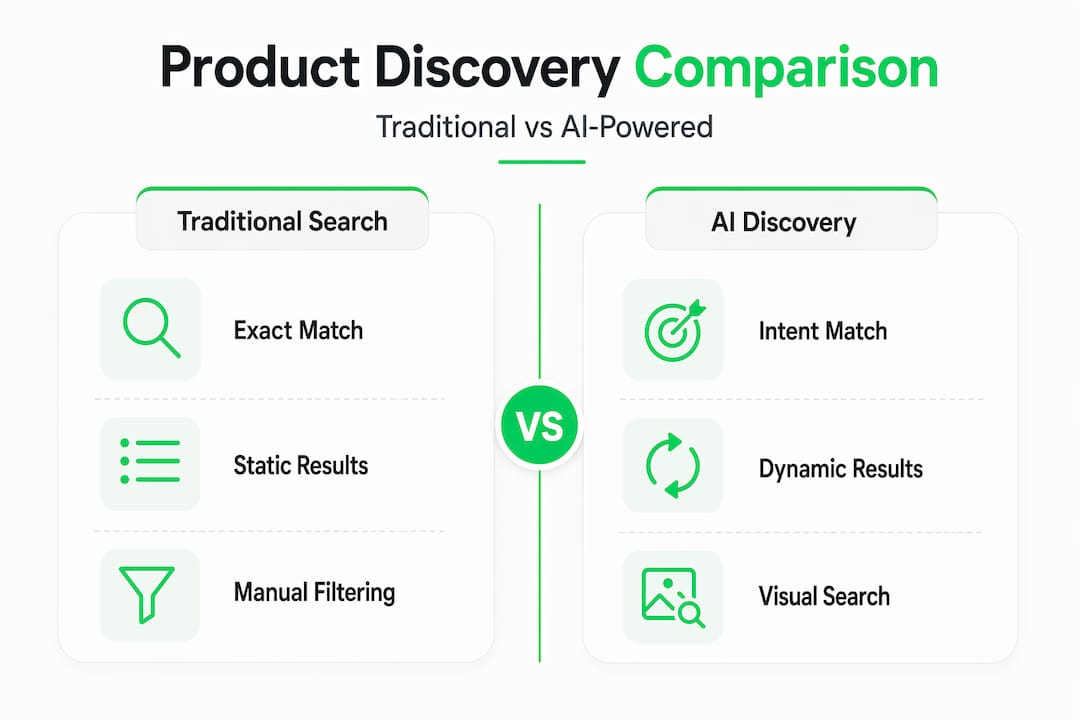
The table above shows the gap clearly. Traditional search puts the burden on the shopper to know exactly what they want and how your catalog labels it. AI discovery meets shoppers where they are.
A few things AI-powered discovery does that traditional search cannot:
- Handles ambiguity: "Something modern but not cold" is a real query AI can interpret. Traditional search returns nothing.
- Learns across sessions: If a shopper keeps looking at walnut-finish pieces, AI surfaces more of them without the shopper having to filter again.
- Connects the catalog: AI can recommend a coffee table that matches the sectional a shopper just added to their cart, increasing average order value.
For Shopify retailers, the practical implication is clear. You can see how Aifurniture's tools for retailers are built specifically around these discovery gaps in the furniture category.
Strategic steps for furniture retailers to implement AI-powered discovery effectively
Having seen why AI matters, here are concrete steps you can take to prepare and succeed with AI-powered product discovery in your furniture store.
The most important thing to understand upfront: product discovery is a data infrastructure problem first. Incomplete or inconsistent product data drastically reduces AI effectiveness and conversion rates. You can't bolt AI onto a messy catalog and expect results.
- Audit and standardize your product data. Every product needs consistent attributes: dimensions, materials, style tags, color families, and room types. If half your catalog says "grey" and half says "gray," your AI will treat them as different products.
- Write descriptions in customer language. Add natural language descriptions alongside technical specs. "Perfect for small apartments" and "seat height: 17 inches" should both appear in your product data.
- Integrate AI visualization using real product photos. You don't need 3D models. Tools like Aifurniture work from high-quality static photos to place products in customer room images. The guide to letting customers see furniture at home walks through exactly how this works.
- Connect online discovery to in-store visits. Successful retailers combine AI tools with in-store experiences to guide high-intent visitors from online discovery to showroom appointments. If someone has visualized your sofa in their room three times, they're a warm lead for an in-store visit.
- Track discovery-specific metrics. Conversion rate alone doesn't tell you enough. Track discovery depth (how many products a shopper views before buying), search exit rate, and visualization engagement to understand where your funnel breaks.
The IKEA AI visualization case study is a useful reference for how a major retailer approached this at scale. The principles apply even if your catalog has 500 products instead of 50,000.
Pro Tip: Set up a "discovery health" report in your Shopify analytics. Track the percentage of sessions that include a search, the percentage of those searches that return zero results, and the exit rate after zero-result pages. Those numbers will tell you exactly where your data is failing your customers.
Maximizing customer engagement with AI furniture visualization
To put AI discovery into action, let's examine the powerful role of AI-driven furniture visualization in enhancing customer engagement.
The biggest misconception about AI visualization is that it requires expensive 3D modeling or augmented reality hardware. It doesn't. Static-photo-based AI visualization, where a customer uploads a room photo and your product is placed inside it realistically, delivers most of the confidence benefit at a fraction of the cost and complexity.
Here's what AI furniture visualization does for your discovery funnel:
- Reduces the imagination gap: Shoppers no longer have to guess whether a piece will work. They see it.
- Increases time on product pages: Shoppers who use visualization tools spend significantly more time engaging with products, which signals intent and improves your conversion probability.
- Encourages broader discovery: When a shopper visualizes one piece, they often explore complementary items, increasing average order value.
- Creates shareable moments: Customers share their room visualizations with partners or family members, extending your reach organically.
AI visualization tools boost conversions by 22% and increase product discovery depth by 25% by enabling customers to see furniture in their actual rooms rather than on a white studio background.
The psychology of furniture visualization shows that the emotional engagement created by seeing a product in your own space is qualitatively different from seeing it in a showroom photo. It shifts the mental frame from "does this product exist?" to "this product is already in my home." That shift drives purchases.
You can see this in practice through the Aifurniture demo, which shows exactly how the room visualization experience works from a shopper's perspective.
Why product discovery is a data problem, not just a UX problem
Here's a perspective that may challenge common assumptions about what truly drives successful product discovery.
Most Shopify furniture retailers who struggle with discovery spend their energy in the wrong place. They redesign their navigation, add more filters, improve their photography, and tweak their search bar placement. These things matter at the margin. But they don't fix the underlying problem.
Most retailers fail because they treat product discovery as a UX problem rather than a data infrastructure problem. When your product data is incomplete or inconsistent, AI tools skip those products entirely. A beautiful interface sitting on top of bad data is still bad discovery.
Think about what AI actually needs to work. It needs structured attributes to match intent. It needs accurate dimensions to answer "will this fit?" It needs consistent style tags to power "you might also like." It needs real, high-quality photos to enable visualization. None of that is a UX problem. All of it is a data problem.
The retailers who win at AI-powered discovery in 2026 are not the ones with the most sophisticated front-end. They're the ones who spent six months cleaning their catalog before they integrated a single AI tool. That unglamorous work is the actual competitive advantage.
This also means that the ROI on catalog enrichment is higher than most retailers expect. Fixing your data doesn't just improve AI performance. It improves every part of your ecommerce operation: search, recommendations, email personalization, paid advertising, and in-store lookup tools.
If you're evaluating where to invest, start with your data. Then look at tools like those on the Aifurniture pricing page to understand what becomes possible once your foundation is solid.
Explore AI furniture visualization tools to transform your Shopify store
Now that you understand the importance and mechanics of AI-powered discovery, here's how Aifurniture's specialized tools can help you apply these concepts easily and effectively.
Aifurniture is built specifically for furniture retailers on Shopify who want to reduce cart abandonment and increase customer confidence through AI-powered room visualization. The platform lets your customers upload a photo of their actual room and see your products placed inside it, using real product photos rather than 3D models or complex integrations.
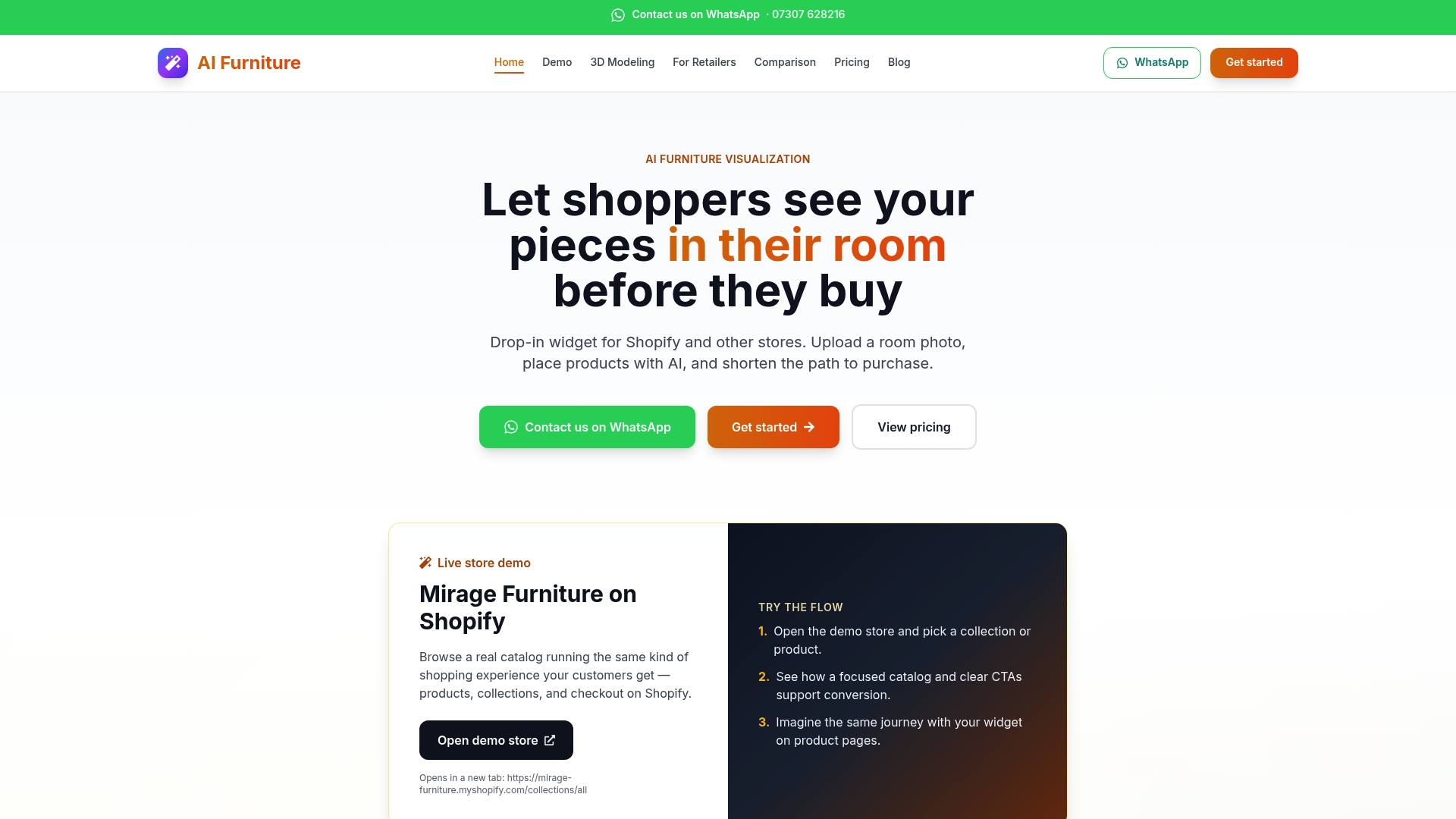
Getting started doesn't require a technical team or a catalog overhaul. The drop-in widget integrates directly into your Shopify store, and the live demo lets you experience the shopper journey firsthand before committing. Whether you're running a boutique furniture brand or a large multi-category store, the tools available through Aifurniture for retailers are designed to deliver measurable results from day one. Visit Aifurniture to see how AI visualization can become your most effective discovery tool.
Frequently asked questions
What exactly is product discovery in furniture ecommerce?
Product discovery is the end-to-end process of helping customers find, evaluate, and choose furniture through AI-driven search and personalization that understands shopper intent beyond simple keyword matching.
How does AI improve product discovery for furniture shoppers?
AI interprets natural language queries, enables visual search, and personalizes recommendations based on behavior. Machine learning and NLP reduce search friction and surface the right products faster.
Why do many furniture retailers struggle with product discovery?
Most retailers focus on interface design when the real problem is their product data. Treating discovery as a UX issue rather than a data infrastructure problem limits how effectively any AI tool can perform.
What role does AI furniture visualization play in reducing purchase hesitation?
AI visualization tools let customers place your products into photos of their own rooms, which removes spatial uncertainty. Seeing furniture in their own space gives shoppers the confidence to commit to a purchase.
How can furniture retailers start implementing AI-powered product discovery?
Start by standardizing and enriching your product data, then integrate AI search and visualization tools. Structured data combined with in-store experiences creates the most complete discovery journey for high-intent shoppers.
Does AI product discovery only improve conversion rates?
No. Beyond conversion lifts, AI discovery increases engagement and builds loyalty by creating personalized shopping journeys that keep customers coming back across multiple sessions.
Recommended
- Let Customers See Furniture in Their Home Before They Buy | Complete Guide 2026
- AI Furniture — visualize products in your customers' rooms
- Let Customers See Your Furniture in Their Home Before They Buy | AI Furniture
- Case Study: How IKEA Increased Online Sales by 60% with AI Furniture Visualization | AI Furniture Placement Blog
Try AI furniture visualization on a live store
Pay per click — 10p per preview ($0.13 USD via Shopify), no setup fee. See room preview on our Mirage Furniture Shopify demo.